
New styles of strikes and protest are emerging in the UK
 This article by , PhD Candidate in Employment Relations, at 黑料不打烊 Business School and , Professor of HRM & Employment Relations, was originally published on . Read the .
The image of strikers picketing outside factory gates is usually seen as something from the archives. show an almost perennial decline in formal strikes. In the month of January 2018 there were 9,000 recorded working days lost due to strikes 鈥� a tiny fraction of the 3m recorded in January 1979.
Yet there has been a noticeable in private sector working days lost from strike action. In January 2018, the figure stood at 231,000 working days lost. That is 146,000 more days than in January 2017 and 166,000 more than than January 2016.
And it鈥檚 not just those on the left who are striking. Workers are also agitated in modern and union-free enterprises. For example, Ryanair was forced after pilots across Europe threatened industrial action, despite its flamboyant CEO, Michael O鈥橪eary, 鈥渉ell would freeze over鈥� before his company recognised a union. in Cambridge and London also went on strike over pay and zero-hours contracts late last year, with talk of .
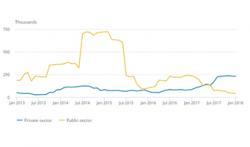 Working days lost in the UK (cumulative 12-month totals, not seasonally adjusted). : Labour Disputes Inquiry, Office for National StatisticsThe beginning of 2018 witnessed some high profile strikes in key sectors: at a number of railways ; at water company over pay and working conditions; at IT giant Fujitsu over ; and thousands of lecturers across more than 60 universities .
What鈥檚 all the fuss about?
People are worried about their pay, working conditions, future earnings and security at a time when the world of work is changing.
University lecturers are angered not only at the reduced pension deal being offered by their employers鈥� group, Universities UK. Views are mixed but many are also , the University and College Union, for recommending an offer that some and members view as falling short on their demands.
Evidently conflict has not been eradicated from modern workplaces. Employees in multiple sectors also protest in other ways , minor , mischief or . The Centre of Economic and Business consultancy reports year-on-year since 2011. Short disputes and other types of protest are excluded from official strike statistics 鈥� hence, many go unnoticed.
Newer patterns of resistance include over precarious zero-hour contracts, 鈥渓unchtime protests鈥� such as those at and Bentley cars, government lobbying by over a takeover, or worker sit-ins as staged by hundreds of over pay. Meanwhile in with striking lecturers.
The shadow of Brexit
Predicting cause and effect for social phenomena is difficult. Protests are often attributed to employment and economic cycles, combined with changing social values of younger people.
The emergent wave of dissent may indicate we are approaching what some economists call a long-wave 鈥溾�� 鈥� named after the Russian economist Nikolai Kondratieff. Here economic cycles can stretch over longer periods 鈥� say ten, 20 or 40 years.
If the mid-1990s was an 鈥渦pswing鈥�, slumping with the 2008 financial crisis, growing dissent may signal another , fuelled by fears of the UK鈥檚 fragile future. For instance, in July 2017 the UK鈥檚 fiscal watchdog warned that Britain鈥檚 were worse than on the eve of the financial crash. Coupled with the Conservatives losing their majority in government, it may be that the real is only now materialising and compounding the .
Another reason may be because have plummeted, while unemployment is at its lowest since the peak of strike activity in the mid-1970s (), thereby giving workers a greater degree of confidence in pressing their demands.
Changing social values
Another possible explanation is that people now expect more and want immediate change. This is exemplified in shock votes for Donald Trump in the US, Brexit or even Jeremy Corbyn鈥檚 popularity.
A new moral consciousness may even have replaced a former industrial working-class ideology. Younger and female labour market participation rates have burgeoned but so too has the and . Multiculturalism, social inclusion, global employment issues are all catalysts for pioneering .
People are not satisfied with this status quo and are calling for change. So, as well as the more traditional style of organised action, some workers are expressing this new potential moral consciousness with subtle active protest such as the lunchtime protests, worker sit-ins and social media campaigns.
Analysis also points to 鈥渃onflict benefits鈥�: for example striking lecturers report , renewed energy and an enjoyment of the solidarity that comes from protest. Research also shows that conflict can support creativity and open disagreement .
Whether we are entering a Kondratieff upswing or witnessing a new active moral consciousness is unclear. Nevertheless, it may be that protest can produce positive outcomes not only for workers, but also help companies to better engage with their workforce.
Publication date: 10 April 2018