黑料不打烊

Skip to main content
Home

Information for:

  • Alumni
  • Applicants
  • Parents
  • Cymraeg
My country:

Main Menu

    • Undergraduate
      • A鈥揨 of Courses
      • Subject Areas
      • How to Apply
      • Already Applied
      • Applicant Hub
      • Fees and Finances
      • Scholarship and Bursaries
      • Widening Access
      • Study in Welsh
      • Part-Time Study
      • Degree Apprenticeships
      • Study or Work Abroad
      • Work Experience
      • Student Accommodation
      • Pocket Prospectus
      • Academic Calendar
    • Postgraduate Taught
      • A-Z of Courses
      • Subject Areas
      • How to Apply
      • Fees and Finances
      • Scholarships and Bursaries
      • Executive Education
      • January Start
      • Part-Time Study
      • Short Courses and CPD
      • A-Z of Short Courses and CPD
    • Postgraduate Research
      • A-Z of Courses
      • Subject Areas
      • How to Apply
      • Funding
      • The Doctoral School

    Find a Course

    Open Days

    Postgraduate Event

    Applicant Hub

    Virtual Tour

    Order a Pocket Prospectus

    • Student Life
      • Student Life Home
      • 黑料不打烊 and the Area
      • Social Life and Entertainment
      • Student Accommodation
      • Clubs and Societies
      • Sport
      • Virtual Tour
      • Videos and Vlogs
    • Your Experience at 黑料不打烊
      • Student Support
      • Skills and Employability
      • Study or Work Abroad
      • Fees and Finances
      • Student Ambassadors

    Student Profiles

    Student Videos and Vlogs

    Virtual Tour

    • Choose 黑料不打烊
      • A-Z of Courses
      • International Home
      • Why 黑料不打烊?
      • Location
      • Accommodation
      • Student Support
      • Contact Us
    • Apply
      • Entry Requirements
      • Tuition Fees and Scholarships
      • How to Apply
      • Already Applied
      • Study Abroad (Incoming)
      • Exchanges (Incoming)
      • Worldwide Partners

    May Intake Courses

    Your Country / Region

    黑料不打烊 International College

    Find a Course

    • Research
      • Research Home
      • About Our Research
      • Research in our Academic Schools
      • Research Institutes and Centres
      • Integrated Research and Impact Support (IRIS) Service
      • Energy
      • REF 2021
      • Research News
    • Postgraduate Research Opportunities
      • Postgraduate Research
      • Doctoral Academy
    • Events and Training Opportunities
      • Researcher Development

    Royal Recognition: 2023 Queen's Anniversary Prize

    黑料不打烊 Research In Top 30 For Societal Impact In UK

    • The University
      • About Us
      • Our Mission
      • Strategy 2030
      • Annual Report & Financial Statements
      • Our Location
      • Academic Schools and Colleges
      • Services and Facilities
      • Vice-Chancellor's Office
      • Working with Business
      • Working with the Community
      • Sustainability
      • Health and Wellbeing
      • Contact Us
    • Working for Us
    • University Management and Governance
      • Policies and Procedures
      • Slavery and Human Trafficking Statement
      • Management and Governance
    • University and the Community
      • Pontio
      • Sports Facilities
      • Conference Facilities
      • Places to Eat and Drink
      • Public Events
      • Widening Access
      • Services to Schools
    • Business Services
      • Business Services Home
    • Collaboration Hub
      • Collaboration Hub
    • Conferencing and Business Dining
      • Conferencing Facilities
      • Business Dining
    • Intellectual Property (IP) and Commercialisation
      • Intellectual Property (IP) and Commercialisation
    • News
      • Current News
      • Research News
      • Student News
    • Events
      • Events
    • Announcements
      • Flag Announcements

    140th Anniversary

    Public Lectures

    • Open Days 2025/26
      • Mini Open Day - January 2026
      • Main University Open Days
      • Change / Cancel Booking
    • Prepare For The Open Day
      • Mini Open Day Programme
      • Accommodation Options
      • How to get to the Open Day
      • Open Day Parking
      • Student Support
      • Questions to Ask
      • Undergraduate Subject Areas
      • Welsh-medium Study
      • Food and Drink
      • Frequently Asked Questions
      • Discover 黑料不打烊 and the Area
    • Postgraduate Event
      • Event Information

    Book Mini Open Day - January 2026

    Campus Map

    Virtual Tour

    • Undergraduate
      • A鈥揨 of Courses
      • Subject Areas
      • How to Apply
      • Already Applied
      • Applicant Hub
      • Fees and Finances
      • Scholarship and Bursaries
      • Widening Access
      • Study in Welsh
      • Part-Time Study
      • Degree Apprenticeships
      • Study or Work Abroad
      • Work Experience
      • Student Accommodation
      • Pocket Prospectus
      • Academic Calendar
    • Postgraduate Taught
      • A-Z of Courses
      • Subject Areas
      • How to Apply
      • Fees and Finances
      • Scholarships and Bursaries
      • Executive Education
      • January Start
      • Part-Time Study
      • Short Courses and CPD
      • A-Z of Short Courses and CPD
    • Postgraduate Research
      • A-Z of Courses
      • Subject Areas
      • How to Apply
      • Funding
      • The Doctoral School

    Find a Course

    Open Days

    Postgraduate Event

    Applicant Hub

    Virtual Tour

    Order a Pocket Prospectus

    • Student Life
      • Student Life Home
      • 黑料不打烊 and the Area
      • Social Life and Entertainment
      • Student Accommodation
      • Clubs and Societies
      • Sport
      • Virtual Tour
      • Videos and Vlogs
    • Your Experience at 黑料不打烊
      • Student Support
      • Skills and Employability
      • Study or Work Abroad
      • Fees and Finances
      • Student Ambassadors

    Student Profiles

    Student Videos and Vlogs

    Virtual Tour

    • Choose 黑料不打烊
      • A-Z of Courses
      • International Home
      • Why 黑料不打烊?
      • Location
      • Accommodation
      • Student Support
      • Contact Us
    • Apply
      • Entry Requirements
      • Tuition Fees and Scholarships
      • How to Apply
      • Already Applied
      • Study Abroad (Incoming)
      • Exchanges (Incoming)
      • Worldwide Partners

    May Intake Courses

    Your Country / Region

    黑料不打烊 International College

    Find a Course

    • Research
      • Research Home
      • About Our Research
      • Research in our Academic Schools
      • Research Institutes and Centres
      • Integrated Research and Impact Support (IRIS) Service
      • Energy
      • REF 2021
      • Research News
    • Postgraduate Research Opportunities
      • Postgraduate Research
      • Doctoral Academy
    • Events and Training Opportunities
      • Researcher Development

    Royal Recognition: 2023 Queen's Anniversary Prize

    黑料不打烊 Research In Top 30 For Societal Impact In UK

    • The University
      • About Us
      • Our Mission
      • Strategy 2030
      • Annual Report & Financial Statements
      • Our Location
      • Academic Schools and Colleges
      • Services and Facilities
      • Vice-Chancellor's Office
      • Working with Business
      • Working with the Community
      • Sustainability
      • Health and Wellbeing
      • Contact Us
    • Working for Us
    • University Management and Governance
      • Policies and Procedures
      • Slavery and Human Trafficking Statement
      • Management and Governance
    • University and the Community
      • Pontio
      • Sports Facilities
      • Conference Facilities
      • Places to Eat and Drink
      • Public Events
      • Widening Access
      • Services to Schools
    • Business Services
      • Business Services Home
    • Collaboration Hub
      • Collaboration Hub
    • Conferencing and Business Dining
      • Conferencing Facilities
      • Business Dining
    • Intellectual Property (IP) and Commercialisation
      • Intellectual Property (IP) and Commercialisation
    • News
      • Current News
      • Research News
      • Student News
    • Events
      • Events
    • Announcements
      • Flag Announcements

    140th Anniversary

    Public Lectures

    • Open Days 2025/26
      • Mini Open Day - January 2026
      • Main University Open Days
      • Change / Cancel Booking
    • Prepare For The Open Day
      • Mini Open Day Programme
      • Accommodation Options
      • How to get to the Open Day
      • Open Day Parking
      • Student Support
      • Questions to Ask
      • Undergraduate Subject Areas
      • Welsh-medium Study
      • Food and Drink
      • Frequently Asked Questions
      • Discover 黑料不打烊 and the Area
    • Postgraduate Event
      • Event Information

    Book Mini Open Day - January 2026

    Campus Map

    Virtual Tour

Information for:

  • Alumni
  • Applicants
  • Parents
My country:

Search

Close

Breadcrumb

  • Cymraeg

Share this page:

What language tells us about changing attitudes to extremism

This article by , PhD Researcher,  at the School of Linguistics & English Language, was originally published on . Read the .

The words 鈥渆xtreme鈥,鈥渆xtremist鈥 and 鈥渆xtremism鈥 carry so many connotations these days 鈥 far more than a basic dictionary definition could ever cover. Most would agree that Islamic State, the and attackers, as well as certain 鈥渉ate preachers鈥 are extremists. But what about who attacked the Finsbury Park Mosque? Or who murdered Labour MP Jo Cox? Or even certain media outlets and public figures who thrive on stirring up hatred between people? Their acts are hateful and ideologically-driven, but calls for them to be described in the same terms as Islamic extremists are more open to debate.

The word 鈥渆xtreme鈥 comes from the Latin (as so many words do) 鈥渆xtremus鈥, meaning, literally, far from the centre. But the words 鈥渆xtremist鈥 and 鈥渆xtremism鈥 are relatively new to the English language.

Much language is metaphorical, especially when we talk about abstract things, such as ideas. So, when we use 鈥渆xtreme鈥 metaphorically, we mean ideas and behaviour that are not moderate and do not conform to the mainstream. These are meanings we can find in a dictionary, but this is not necessarily how or when extreme, extremist, and extremism are used in everyday life.

Lingua

One way of finding out how words are used is to look at massive databases of language, called corpora. To find out more about how these words developed in Britain, I turned to the , a collection of parliament speeches, from 1803 to 2005. Political language is quite specific, but analysing it is a good way to see how the issues of the day are being described. In addition, having a record which covers two centuries shows us how words and their meanings have changed over time.

Apart from the adverb 鈥渆xtremely鈥 鈥 used in the same way as 鈥渞eally鈥 and 鈥渧ery鈥 鈥 my search showed that the word extreme was used most frequently in its adjective form during this 200-year period. However, usage of extreme as an adjective has been declining since the mid-1800s, as has the noun form. At the same time, two new nouns, 鈥渆xtremist鈥 and 鈥渆xtremism鈥 begin to appear in the corpus in the late 1800s, and usage gradually increases as time goes on. No longer are certain views and opinions described as extreme, instead extremist and extremism are used as a shorthand for complex ideas, characteristics, processes and even people.
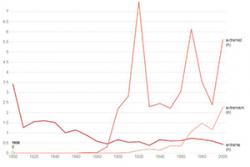
Frequency per million words of the nouns extreme ( bottom), extremist (top) and extremism (middle) between 1803-2005.Frequency per million words of the nouns extreme ( bottom), extremist (top) and extremism (middle) between 1803-2005.In the graph (right), we can see three peaks in the frequency of the noun extremist(s). It is interesting to see which groups have been labelled as extremist in the past as this can provide clues about who is considered an extremist these days, and also who is not.

In the 1920s, extremist and extremism were often used in connection with the Irish and Indian fights for independence from the British Empire. 50 years on, they are linked with another particularly violent period in Irish history, while Rhodesia was also fighting for independence from Britain in the 1970s. The final increase in usage of the terms extremist and extremism comes, perhaps unsurprisingly, at the start of the 21st century.

However, the words have not been solely linked to violence: they were very often used to describe miners in the 1920s and animal rights activists in the 2000s. Both of these groups have had a lot of support from the British population if not from politicians speaking in parliament.

I also looked at the words that appear around the extreme words, or 鈥渃ollocates鈥. What I found is that the collocates of the search terms become increasingly negative over the period covered in the Hansard corpus. They also became less connected to situations, and more closely connected to political or religious ideas and violence. For example, in the late 20th century and early 2000s, 鈥渆xtremism鈥 became more associated with Islam, and at the same time, it was collocated with words such as 鈥渢hreat鈥, 鈥渉atred鈥, 鈥渁ttack鈥, 鈥渢error鈥, 鈥渆vil鈥, 鈥渄estroy鈥, 鈥渇ight鈥, and 鈥渪enophobic鈥.

Extremism

After 2005, the extremist terms became much more frequently associated with the Islamic faith 鈥 to the point where the word 鈥渆xtremist鈥 is now almost exclusively used to refer to a Muslim who has committed a terrorist act, and some have suggested there is .

Looking at the collocates of extremist and extremism in a corpus of , which runs from 2010-2017, five of the top 10 collocates are related to Islam. 鈥淩ight wing鈥 and 鈥渇ar-right鈥 also appear in the top 10. However, the top three collocates 鈥 鈥淚slamic鈥, 鈥淚slamist鈥 and 鈥淢uslim鈥 鈥 appear 50% more frequently than the other seven collocates in the list added together.

The most interesting thing to come out of this investigation is what has gone unsaid. Extremist and extremism are not being used as they were in the past to describe violent, hateful, and ideologically-driven acts, with no reference to ethnicity or faith. Today, the terms have become almost solely reserved for use in reference to Muslims who perpetrate terrorist attacks.

The words we use can affect and reveal how we perceive the world around us. Word meanings change over time, but reluctance to use the same word for the same behaviour betrays a bias towards crimes that are, perhaps, uncomfortably mainstream.

Publication date: 1 September 2017

Home

  • News
    • Latest News
    • News Archive
    • Events
Home

Follow Us

黑料不打烊

黑料不打烊, Gwynedd, LL57 2DG, UK

+44 (0)1248 351151

Contact Us

Visit Us

Maps & Directions

Policy

  • Legal Compliance
  • Modern Slavery Act 2015 Statement
  • Accessibility Statement
  • Privacy and Cookies
  • Welsh Language Policy
Map

黑料不打烊 is a Registered Charity: No. 1141565

© 2020 黑料不打烊